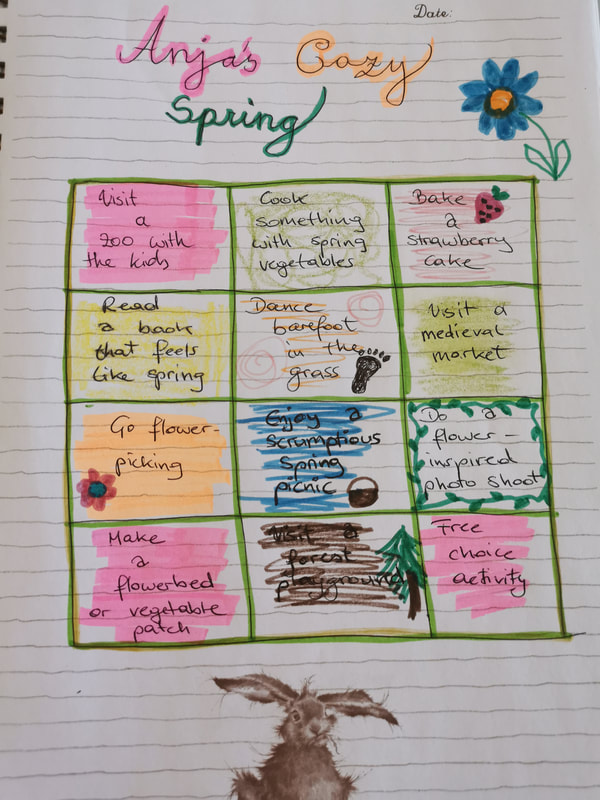
 What would we be without inspiration? Every season has their own way of inspiring me, may it be the summery hues of blue eternal freedom, autumnal oranges and reds (my favourite), the glitter and shine of Christmas, the cold, clean slate of winter, or the blossoming promises of spring. If you remember, I did an Autumn Bucket List (you can also read the update here), and decided to do something similar for spring. Watching a Darling Desi Youtube video, I felt inspired to copy her idea for a bingo-inspired spring list (she does it for summer and has four columns, like actual Bingo sheets do, I think). The great thing about self-made bucket lists and bingo sheets is that you can choose activities you will actually do - so, as it's already late April, let's dive in and see what I've already accomplished. Note: A bucket list should never add to your stress - don't make yourself miserable not completing your sheet or list - remember, the next spring will certainly come around ;-) Visit a zoo with the kidsSpring brings new babies to zoos - the perfect time to visit. We went to Vienna in March and went to the Viennese zoo and the children (and us) loved it. We saw the feeding of the sea lions, a few babies and enjoyed quality family time. A perfect spring outing! Cook something with spring vegetablesPeople who have followed me for a while know I'm not a very good cook, nor do I enjoy cooking. However, I'm trying to get better at it and engage more with the produce I'm using. Cooking seasonally and regionally is my number one priority - above organic or alternative foods (organic, regional food, is, of course, the best!). So far, I've made two yummy dishes with spring vegetables. I used spinach for making a salmon and spinach pasta dish, which was really good. We also had asparagus with sauce hollandaise and salted potatoes (simple, but very nice). As my husband predominantly made the second dish, I'll share the recipe for the pasta: For the spinach-salmon-pasta I used: frozen salmon (defrosted) fresh spinach from the farmer's market Spaghetti pasta garlic olive oil I sauteed the garlic in the olive oil and grilled the salmon gently. At the same time, I boiled the pasta in the pot. I added the spinach to the pan with the salmon and lastly added a scoop of pasta water and the pasta to the pan (make sure to take a big one). Let it all cook for a minute or two, grate some fresh Parmesan on top and enjoy. Bake a strawberry cake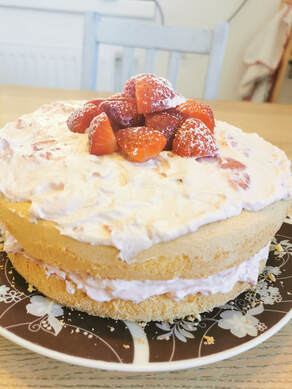 Does anyone scream spring more than fresh strawberries? Soft sponge, light cream and scrumptious strawberries is all you need. I already baked a delicious strawberry cake earlier this month and it turned out perfect. It was, in fact, my first perfect cake. As the recipe is quite long, I've linked it here and you can find it in my recipes section. Read a book that feels like springI'm always on the hunt for a good read, but I haven't found a book yet that intrigued me that screamed "spring"! I have, however, just downloaded the book "The Garden of Lost and Found by Harriet Evans, and I hope the content is as mesmerising as the cover. I generally tend to be more drawn to autumnal/wintery books. I tried giving an example of books I've read in the past, but they all have a very cold vibe to them. However, two very spring-like book series are Starry Hollow Witches and the Spellbound Series by Annabel Chase. They're not the best written books, but very enjoyable nevertheless. Visit a medieval marketOn the last April weekend we went to the renaissance faire in Rattenberg, Tirol. Rattenberg is an old town nestled between mountainous peaks with historic buildings that are crooked enough to make you wonder if they will hold up much longer. It was the perfect setting for a medieval vibe and you know how much I love an occasion to dress up. We got into medieval dress-up when my cousin got married medieval-style, and we have loved it ever since. Go flower-pickingI think flower-picking needs to be on every good spring to-do list, as it's a simple, enjoyable task that leads to a home-made bouquet. One would think this item was the easiest to cross off the list, and yet it took me two full weeks until I didn't forget to "smell the flowers" on our walks. A gentle reminder to be more in the present, actually smell the flowers and probably pick a few for a nice meadow-made bouquet. I actually even forgot to take a picture of our lovely little flower bundle, but they were yellow dandelions (are there any non-yellow dandelions, I'm just wondering...). Enjoy a scrumptious spring picnicIs there anything screaming spring more than a picnic? Picnics are quintessentially spring/summer things. Fresh strawberries warmed by the sun, scrumptious scones with jam and cream, finger sandwiches and home-made iced tea in a bottle. Sadly, we have not been able to do a picnic so far with the second round of winter, but now that the weather is becoming much warmer, we will definitely do it - hopefully even this week with the little man turning two years old (can you believe it? I can't!). Do a flower-inspired photo shootInspired by my Autumn Bucket List photo shoot (which you can find here), I also want to do something spring-inspired, but have sadly not come around doing it yet (again, I blame the weather), but these completely unrealistic AI-generated photo shoots above are the general aesthetic I would go for - let's see if I can get it done in time or have to push to next year's list. Make a flowerbed or vegetable patch/visit a forest playgroundBoth are still up for grabs - AGAIN due to inclement weather - but we got some small wooden crates from my father that are like a very low raised bed and I would love to start growing pumpkins, salad and strawberries, so the kids can help me with the "harvest". In the next days we also want to visit one of the many great forest playgrounds we have here - I'll keep you updated. Spring may feel like it's already on its last legs, but a spring bucket list can help to really enjoy those wonderful spring days before the summer heat takes over.
0 Comments
Yes, yes, yes, I know, autumn technically lasts well into September, but let's be honest ... the moment November stretches his tender fingers, we start humming Christmas songs and winter is literally coming (Game of Thrones reference intended).
So, let's update the Autumn Bucket List, cut my losses, celebrate my wins, and make space for my Christmas list (soon to follow). You can find the original Autumn Bucket List here, with all my goals and intentions.  Over ten days ago, I started a diet that allows neither sugar nor gluten - and with no sugar, I mean no fruit, no honey, no syrup, no sweeteners, nothing.
It all started with visiting an alternative doctor who specialises in the gut. He quickly identified a parasite in my liver and an unbalance in my gut bacteria. He recommended a two-week course of a sugar and gluten-free diet to cleanse out my entire gut.  Image by PublicDomainPictures from Pixabay It is October! I can't believe September is already over. I can never wait for the -ber months to start, as autumn and the Christmas time are, by far, my favourite time of the year. September usually kicks off autumn with a crisp edge in the air and the unmistakable back-to-Hogwarts vibes. Sadly, this year, September was summery and warm and we've barely had any autumnal days yet. The trees are still very green and all my autumnal sweaters rot in my closet. Now that October has commenced, I really want to get into autumn spirit, regardless the weather. October is for me all things spooky and pumpkin. I love the orangeness of October, the warmth interspersed with the spookiness of cold grey and black. As November is almost Christmas-time already, I often feel autumn is really just September and October, so I really want to make the most of them. This year I have compiled an "Autumn Bucket List" to help me really embrace the season, and while autumn started almost two weeks ago, I only now came round to posting this. I hope I can do all of the things on my bucket list, but anything I can't do this year will instantly go on next-year's autumn bucket list, so let's delve in. 1) Spend an afternoon in your local bookstore and enjoy a cup of tea Image by Birgit Böllinger from Pixabay OK, let's talk about assholes. No, I don't mean people who are behaving rudely, but actual buttholes. This blog isn't for anyone who has the mindset of a Victorian lady, as there will be a detailed description of how I managed to get a persistent and awfully painful anal fissure under control. Some might now think, "Hey, Angie, cheers, but that's too much information." But I disagree. Sadly, we still don't talk about butt pains and many people suffer in silence. I, also, felt disgusted by myself because I had this anal issue, and felt alone with it. Only when I stumbled upon this forum did I realise that many more women were suffering from the same thing - often having it for decades without getting any real help from doctors.
And this is why I am sharing it here, even though it might seem like an awfully intimate issue. Maybe you're suffering from a fissure, maybe you will in the future, maybe you never will but have other issues. I just know that I got an issue under control that seemed to completely overtake my life - and should you suffer from the same, I wouldn't want you to suffer simply for a lack of information, so here I am sharing my therapy with you. # But first, I'm going to tell you my whole dreadful story with it. If you just want to skip down to the healing part, you can do so, of course.  When typing in the hashtags #gentleparenting or #attachmentparenting in the search engine of Instagram, they yield over 800.000 and 600.000 hits, respectively. When you are on social media, it is almost impossible to not stumble upon post after post of "free-range" children, Montessori playrooms and ways to gentle-parent your child. It almost seems like a barrage of hacks, tricks and methods to use for your child. Gentle parenting, at this point, is the prevalent parenting strategy, particularly among higher educated people. The parenting book shelves are lined with gentle approaches to your tot's tantrums and sleep solutions. The internet is flooded with self-righteous parents who share their opinion on, well, pretty much everything (and one of their blog posts you're reading right now). Gentle parenting is the trend, but what does it actually mean, and are there any pitfalls to the approach?
And it's already been Easter again - can you believe it? The year is racing past, and next week it will already be my birthday! I do hope you had a wonderful Easter. It was the first time that we celebrated it at our place. Same as with Christmas, we figured it is just so much easier with the two kids to do it at our place, so let me share what we did. On Good Saturday, we have this somewhat strange family tradition on my family's side. As long as I can remember, we always went to look at the Jesus graves. In Austria - a Catholic country - at Easter time, churches display colourful graves with a dead Jesus inside them and you can go and look at them (I know, writing it down here, I only realise how weird that actually is). This year, we decided to do it as well, even though it is quite cumbersome with two little children because you have to get them in and out of the car so much. Lily is still obsessed with anything Jesus because of the Jesus baby from Christmas. She was, however, rightfully confused from the jump of "let's look at a manger at the little Jesus baby" to "Let's look at the dead Jesus lying in a grave." The most important part of these outings, which is always the most important in my family with anything, is the cake that is consumed after looking at two to three graves. 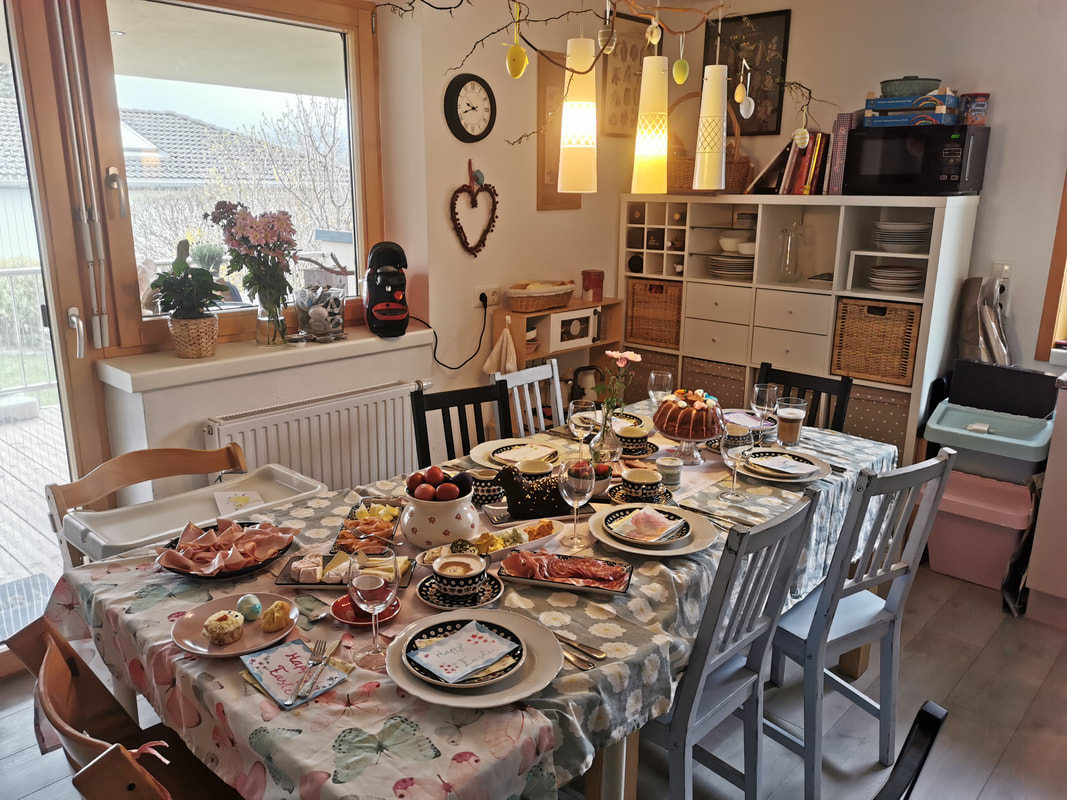 Our Easter Brunch table 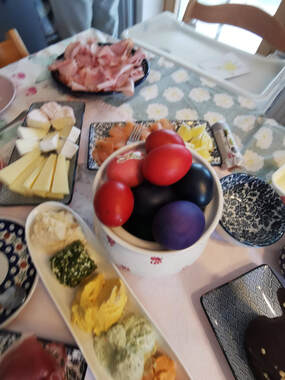 On Easter Sunday, we all met at our place for brunch. It is still new to me to host this mega-family events, and I have to say I have newfound respect for my mum and her ability to get everything done and ready on the table in time. As I am not such a fan of the traditional Easter brunch food (horse radish, baked ham and "Pinzn" (a sweet kind of bread), I decided to make a sweet brunch with waffles, mascarpone cream and cake, as well as salmon, spreads and cold cuts. It was delicious and a lot (we always have to much food in our family - but better too much than too little, right?). As the weather, as per usual, was abysmal, we decided to do the Easter hunt inside the apartment. I hid some sweets and presents for Lily and my mum and sister insisted on hiding their presents as well, but I knew Lily would be completely overwhelmed with so many things - and that was exactly what happened. She found one chocolate bunny and her new book on ballet and then just wanted to sit down, eat her bunny and read her book. She wasn't even remotely interested in continuing the hunt. The amount of presents and sweets the kids get is something that bothers me. I grew up with what many would say as " a little over the top" in that department. My mother comes from a family where showering people with money, sweets and presents is a form of showing your love (and maybe a little bit of status), and it's definitely an issue for me raising my kids. Lily, being two, is overwhelmed when there are too many presents to open and too many people cooing "Look Lily, there is another present for you!", "Come on, Lily, I think I found another present over there." It's overwhelming and puts her on the spot. We also have VERY much in terms of toys, and I really want to get a handle on that, but I will dedicate an entire blog post to that in the near future. 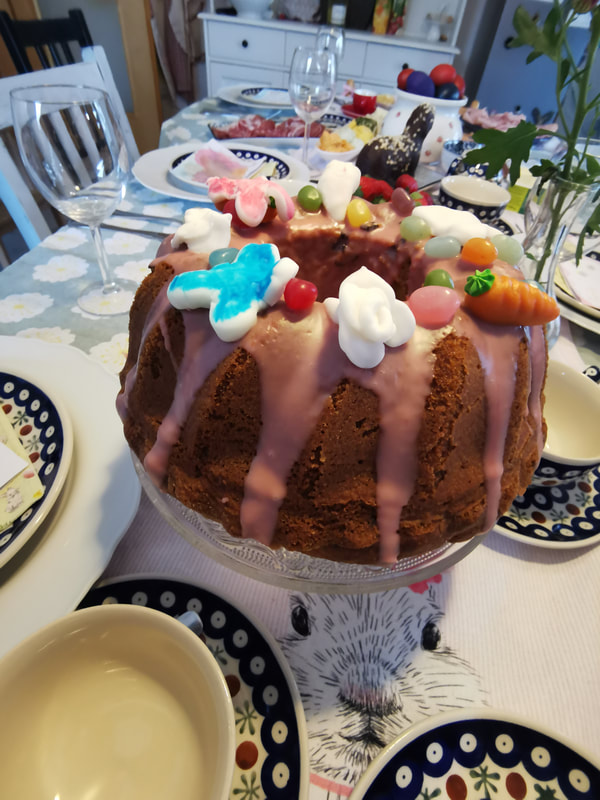 I was also really proud about the baked goods I prepared for Easter. I made a traditional Bundt cake with toppings, which I haven't even tried yet because we had so much food to eat that I ended up freezing it. I also tried out these cute chicken cupcakes and I will leave the recipes for the baked goods in the Recipe Section.
All in all, we had a very pleasant Easter Sunday and wrapped it up with a family trip to the zoo on Easter Monday, the only nice day in weeks (it's actually snowing while I'm writing this post!). I hope you had a lovely Easter time, too. #mamablogger #easter #blogging #blog  With your first child, you are always eagerly awaiting every milestone. At least that was how it was with Lily. When will she crawl? When will she walk? When can we bake cookies together? When can we go tobogganing together? Etc. We were always eager for the next step forward, looking forward to all the things we could do "when only she will...".
With Finn, the story is very different. Now, I bemoan that he's not my little newborn anymore - maybe because I know it might be my last time having a baby (we're still on the fence with that), but also because I already have another that has "done the milestones". I am grateful for every day he sits and doesn't crawl, because it makes our day much easier if I can park him somewhere and he's condemned to stay there (as mean as that sounds). But, having a toddler, it is also much easier with the second one to really appreciate the baby years. I love both of my kids equally (not every day, but in general). While Lily is incredibly cute with her garbled speech and her bossy tyrant-like tendencies, Finn is just unobjectively cute. There isn't much personality or attitude yet, but he's squishy and big enough to smile, laugh, eat, grab, play, etc. And seeing a tiny person doing all these things - with some shaky attempts - is just beyond adorable. Comparing (and I don't like to compare them, but it involuntarily happens), the baby years are so much simpler than the toddler years. While it's such great fun when your toddler tells you to be quiet and just watch her do it (the confidence, the cheek!), it's also constant negotiating, telling off, bargaining and frustration on both ends. Allowing independence is important, but also requires constant supervision and just the right amount of help and taking a step back. On the weekends when my husband is home, I get to spend one-on-one time with Finn. We can lie down to breastfeed and to put him down for his naps - and I love it. Now, I wonder what I did when Lily was a baby. You've got so much time on your hands. I would spend so much time in bed if Finn was my only baby. And I did with Lily, but I didn't appreciate it at the time as much as I now think I should have. There was always the waiting for the milestone, while now, knowing he will become a bossy toddler within the blink of an eye, I can't get enough of our bed-breastfeeding-cuddles. However, there is one thing I still have to mention. Motherhood with Finn is so much easier - simply because he is the second one. While Lily made me a mother, Finn made me a confident mother. If he was my firstborn, I'd still not be able to appreciate it, because he'd be my firstborn. I'd be stressing about whether I'm doing enough, when, how and where he's going to develop (I'm still doing that sometimes, but it's more like an annoying background noise instead of a scream in the middle of the night). "If only I could have had the confidence I had with my second-born when I had my firstborn", a dear friend of mine recently lamented. But that's the catch, isn't it? You need this first pancake where you don't know whether the pan is too hot, the batter to thick or thin, to then make the rest confidently. And while Lily was showered with attention, being the firstborn, I feel she also has to pay the bigger price in terms of having a relaxed mum. She got a lot more heat from my insecurities than he will ever get. And imagine how much cooler I'd be with that third-born (we might find out, or we might not). The baby years are often unfairly called "the boring years", but I think that's undeserving. Every age has its ups and downs, but I must say that the baby years have plenty more ups than downs (I'm still not so sure about the toddler years, as cute as they are...). I also have to add, of course, that Finn is a true delight. He is low maintenance, happy 90% of the time and an easy sleeper. If he were a cry baby, I'd think very differently, perhaps, but as for us and now, I'm appreciating his unequivocal cuteness and gratefully accept every day that he's my little bundle of joy and every day where I am still God in his perception and just my presence is enough to make everything right again :-) #motherhood #motherblog #bloggingmum #babyyears 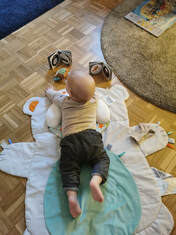 Hello, hello and welcome back to my blog! Today I want to write about family life as a mum of two under two and Finn's 4-month-old update. Can you believe this little bugger is already 4 months old! I feel the newborn stage just raced past us and now he's already keeling to one side to turn on his belly. The main reason why I want to write about my kids' progress once a month - ideally - is because of this racing. It is insane how quickly time passes, even though the days can feel sooooo long sometimes when I count the hours until my husband comes home to relieve me, so I can shower, eat, or even just to take a dump without a baby on my lap (you're welcome for the visual).
Finn is now amidst his fourth leap (according to The Wonder Weeks book and app, in case you're not familiar), and this leap has been kicking our butts. Also described as one of the most challenging for parents, I can wholeheartedly subscribe to that. In short, he's been a proper little sucker on some days in the past weeks. And I mean, literally. I feel if I'd let him, he'd be on my boobs 24/7. He has this glorious thing where he just falls into a coma in the afternoon and conks out for three, sometimes four hours at a time, but, as nice as that is, I feel he has to catch up on milk supply during the nights - and I KNOW, the simple solution would be to wake him up earlier, but I try to also get some quality time with Lily, so...pros and cons. Speak of the devil. Lily has just turned two and we couldn't be more in love with our little toddler. She's talking endlessly - mostly about what we're NOT allowed to do (Her favourite word is "nit", which is Tyrolean dialect for "not"). She's turning into a proper boss bitch and empress of the family, but as she's so darn cute, we mostly forgive her. What she enjoys doing most at the moment is reading books, books, books. It's so funny, we have this one wimmelbook where a child looks a bit like Harry Potter - and now she's always looking for "Hadi Dotta", I could just die (she also calls the Chinese-looking girl next to the boy "Cho Chang", so I guess she's already got her priorities straight). Meanwhile, a new struggle blossoming (so you don't think we're like a freaking unicorn rainbow family), is getting Lily dressed. She really doesn't like it. Now, as we were in the heat of summer, I didn't care if she said, "Batzi besser" (Being naked is better), but as we're inching towards autumn, I feel like she should get at least a top on, which takes lots of negotiating at the moment. From screaming to flinging her arms around, it can become quite the battle - even though I always try to give her choices (unless I feel they overwhelm her even more), and give her a few naked minutes before I insist she get dressed. Still, I feel we get very little of the "terrible twos", and I think it is partly because we always try to schedule in time for her to put on her own shoes and tell her she can always ask for help. Since she's starting talking and is now talking in half sentences already, communication has become infinitely easier. Usually, unless she's tired or hungry, she does ask for help before having a meltdown and a cuddle can mostly avert all bigger tantrums. However, on the matter of tantrums, it was - and still is - a huge learning curve for me to accept that these big feeling don't mean I am a bad parent. I often tended to deflect her big emotions because it was hard not to take it personally as a parent. A good friend of mine suggested pretending Lily wasn't my child when she had a tantrum - not like ignore her (though sometimes I'd love to do that too ;-)), but to imagine she was a strange child that somehow came upon you and you felt responsible for guiding it through the tantrum (as if you were their nanny, kindergarten teacher, etc). On some occasions this method has helped me to not take it personally and remain calm. As you can see on the picture, Finn has truly mastered the difficult task of lifting his enormous head (thanks for the tear, babe) and can now lie on his stomach to examine his hands, objects, and, his favourite object, himself in a mirror. Sadly, however, at the moment he doesn't like to entertain himself for anything exceeding two minutes - which is also a problem when driving with the car. But I hope he will outgrow these little obstacles, maybe even in month 5. 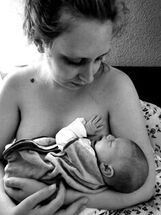 Breastfeeding is a natural process in women - and, yet, many, many women struggle with it, especially in the beginning. I did, too. I breastfed my daughter Lily for sixteen months and am now also breastfeeding my son, Finn. While breastfeeding came without any major issues for me, the start of the experience was completely different for my two kids. Lily and I had a rougher start, including two milk blisters, nipple soreness and an intense surplus of milk. Especially as the start with Finn has been so much smoother, I reflected on what helped me to make it easier for me this time round - although I will say I can only vouch this for myself. Every woman is different, as is every baby and breastfeeding relationship. I can also tell you that my tips are far from inventing-the-wheel-new and you might have heard of them from somewhere else before; however, I share how they helped me and what I did during my two breastfeeding starts. 1. Feed the first time as quickly as possible after birthI think this was the major difference in the breastfeeding beginnings for Lily and Finn. After Lily was born, the midwife and doctors were too busy trying to stitch me up that they didn't help me latching her on. Suddenly, they said I needed to undergo surgery for my injuries and I was wheeled away. As there were some problems with the intubation, surgery took longer than expected and Lily only fed the first time over two hours after birth. By then, she was already really tired again and I had to permanently motivate her to feed.
With Finn, he was put on my chest immediately after birth and started searching. I guided him gently to my breast and he latched on minutes after he was born. The midwives were astonished he latched on so early and well, and it was the beautiful beginning of a wonderful breastfeeding journey. My milk supply was also much more balanced than with Lily, who almost drowned under the cascades of milk spilling out of my boob. |

Angie
Writer. Editor. Blogger. YouTuber. Freelancer. Traveller. English fanatic. Archives
October 2023
|


